|
RESPO PRODUCTS · GAS SAFETY BRIEFING
11 Nov 2026 | Volume 33 of 53 FY26-27
Rugged equipment is only the beginning. Reliable protection needs the right sensor, engineered coverage and a response you can prove.
Field Notes · Oil & Gas Applications
|
|
On a coastal terminal, an offshore facility or a refinery pipe rack, a gas detector faces two challenges at once: detect the hazard and survive the conditions around it. Salt, heat, moisture, vibration and contamination can compromise either task.
The question is not simply, “Is the detector rugged?” It is, “Will this installed system detect the credible release and trigger the required action in time?”
|
|
|
|
Field Requirement 01
Start with the hazards, not the housing
Methane and other hydrocarbons create flammable atmospheres. Hydrogen sulphide adds an acute toxic risk in sour service. Nitrogen purging can create oxygen deficiency, while some tasks require monitoring for specific toxic vapours. A combustible-gas reading cannot answer all of these questions.
Define the gas, concentration range, credible release and required response before selecting the instrument. A standard four-gas portable is not automatically suitable for every refinery or terminal task.
|
|
|
Field Requirement 02
Specify for salt, corrosion and water — separately
Offshore spray, coastal humidity and corrosive process atmospheres attack housings, fasteners, glands and connections. Check material compatibility and corrosion-test evidence, not just the enclosure label.
An IP rating addresses ingress under defined test conditions; it does not prove salt-mist resistance, chemical compatibility or protection against every washdown method. Inspect seals and glands, and use manufacturer-approved weather protection that leaves the gas path open.
|
|
|
Field Requirement 03
Account for real temperature, vibration and power
Direct sun can raise enclosure temperature above the surrounding air. Cold affects batteries and may slow sensor response; condensation can compromise sampling. Confirm both the certified ambient range and the operating limits of the complete configuration.
Mount detectors on suitable supports, away from excessive vibration. Verify earthing, screened cabling and electromagnetic compatibility. Check voltage at the detector at maximum load, including cable losses and loop burden — not just the power-supply output.
|
|
|
Field Requirement 04
Choose a sensing principle that sees the actual gas
Hydrocarbon infrared detectors avoid catalytic-poisoning mechanisms and do not need oxygen for their measurement, but contaminated optics can still impair performance. Standard hydrocarbon IR detectors do not detect hydrogen. Hydrogen needs a suitable hydrogen-capable detector selected for the concentration range and atmosphere.
Catalytic sensors can detect many flammable gases, including hydrogen where specified, but need adequate oxygen and can lose sensitivity through poisoning or inhibition. Toxic sensors have their own cross-sensitivities and exposure limits. Verify every choice against the manufacturer’s data.
|
|
|
Field Requirement 05
Engineer coverage for a moving atmosphere
Wind can carry a leak away from a point detector, while congested pipework creates pockets and sheltered zones. Start at credible release sources such as seals, valves and compressor equipment, then assess airflow, obstructions and accumulation spaces.
LPG vapour is heavier than air; hydrogen is much lighter. These support low-level and high-level placement respectively, but release pressure, temperature and ventilation can override simple density rules. Use coverage mapping or dispersion studies where warranted; density alone is not a siting study.
Open-path detection can complement point sensors across suitable clear paths. Ultrasonic detectors can help identify certain pressurised leaks, subject to leak rate and background noise; they do not measure gas concentration.
|
|
|
Field Requirement 06
Prove the whole response — and protect the worker
Calibration checks measurement accuracy; a gas-response test checks whether the sensor responds. Neither alone proves that the complete alarm and shutdown chain works. Test required outputs and protective actions under a controlled procedure, including fault indications and recovery after maintenance.
For portables, inspect inlets, filters, battery condition and alarms, and bump-test before each day’s use or as the manufacturer requires. Follow calibration instructions and investigate failed tests, over-range events and suspected contamination before returning equipment to service.
For fixed systems, set inspection, gas testing, calibration and proof-test intervals from the manufacturer’s instructions, exposure history and safety requirements. Log bypasses, assign an owner, maintain compensating protection and confirm restoration. Confined-space work still needs its own entry, monitoring and rescue arrangements.
|
|
 |
Before signing off the specification
| ✓ |
Target gases, ranges and environmental limits are documented. |
| ✓ |
Complete equipment approvals match the hazardous area, gas group, temperature class and applicable local requirements. |
| ✓ |
Coverage and access for maintenance are justified for each location. |
| ✓ |
Gas response, faults, alarms and required protective actions have a defined test plan. |
| ✓ |
Spares, calibration gas, trained service support and bypass controls are ready. |
A certified enclosure alone is not proof that the finished detector assembly is certified. Likewise, an ingress rating is not proof of gas-detection performance. Verify the complete instrument and installation.
|
|
|
The Takeaway
Specify for the conditions.
Maintain for the consequences.
Harsh environments do not demand a tougher box alone. They demand a detection system whose sensing, coverage, installation and maintenance all match the duty.
|
|
|
Technical reading: HSE: The selection and use of flammable gas detectors explains core sensing, sampling and maintenance principles for industrial applications. Its stated scope excludes offshore installations; offshore designs need their applicable sector-specific requirements.
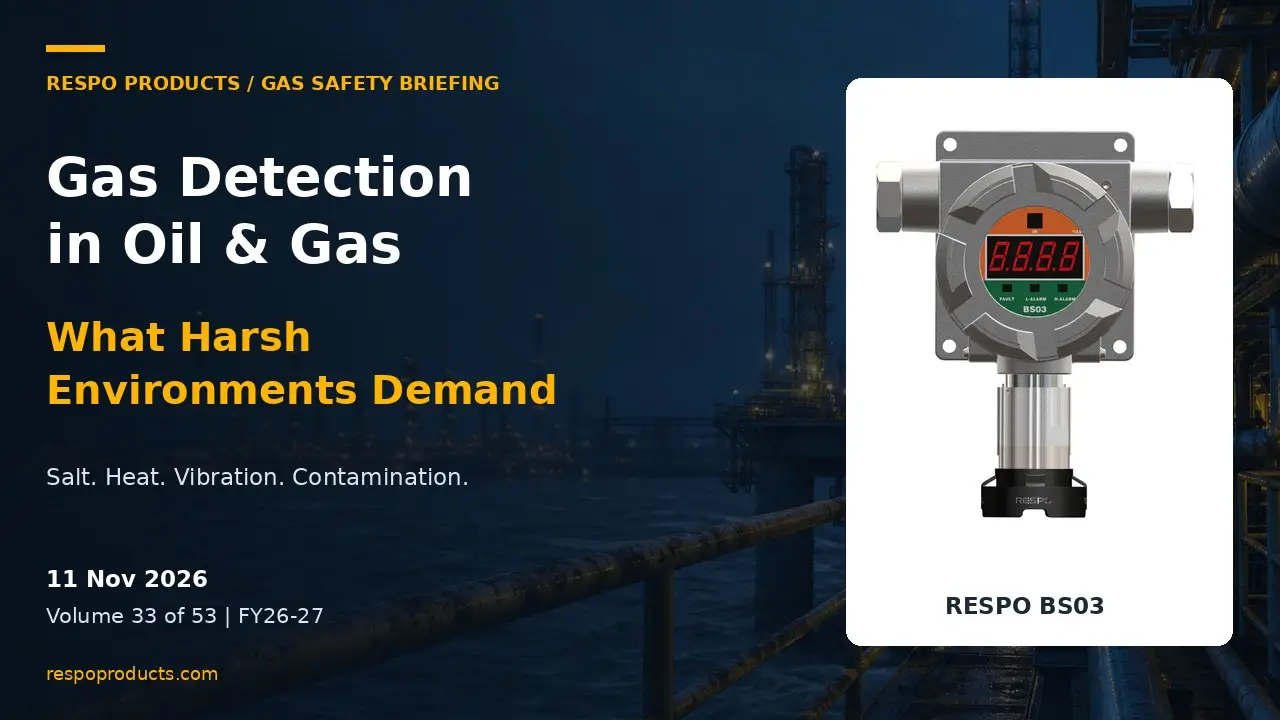
Cover: illustrative industrial scene with the Respo BS03 product photograph; no offshore qualification or specific environmental rating is implied.
|
|
|