|
A warehouse looks different after the shutters close. So does a basement garage when extraction stops, or a service chamber when a maintenance crew opens it. The equipment may be familiar; the atmosphere can change with the task, the shift or the ventilation.
Ask three questions for each space: What could be released? Where could it reach people? What must happen when the alarm sounds? The answers determine what to measure, where to measure it and who needs the warning.
|
|
FACILITY 01
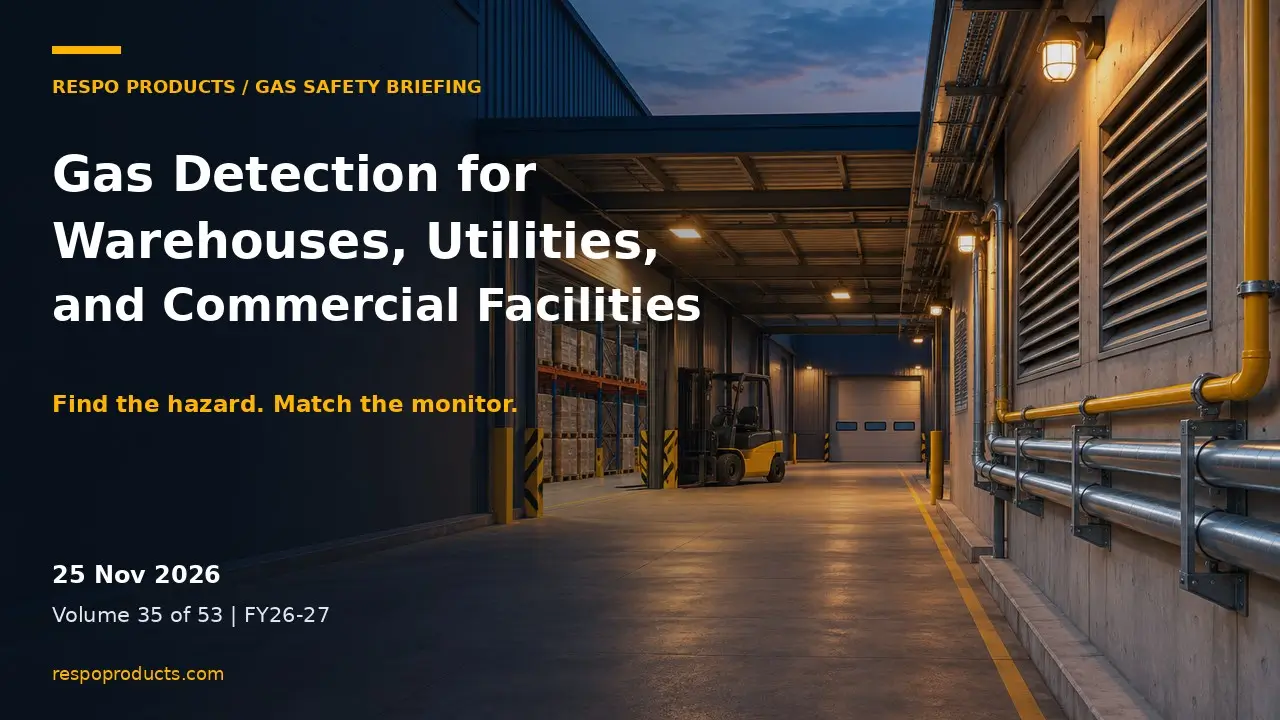
Warehouses and loading docks
Start with vehicles, chargers and cold rooms. Fuel-powered forklifts and trucks can introduce carbon monoxide (CO) into enclosed docks and staging areas. Diesel exhaust can introduce nitrogen dioxide (NO2) as well. Review idling practices, extraction and exposure when shutters are closed; a monitor is not a substitute for controlling exhaust at the source.
Charging lead-acid batteries can release hydrogen. Confirm the battery chemistry and ventilation design before specifying monitoring. If hydrogen detection is needed, use a hydrogen-capable sensor: standard hydrocarbon infrared detectors do not detect it. For cold stores, identify the actual refrigerant. Ammonia and CO2 require different detection and response strategies.
|
|
FACILITY 02
Utilities and service spaces
Separate leaks, combustion products and oxygen deficiency. A boiler room may need combustible-gas detection for fuel leaks and CO monitoring for combustion or flue problems. One reading cannot stand in for the other.
At wastewater lift stations, wet wells and valve chambers, assess hydrogen sulphide (H2S), methane and oxygen deficiency as separate hazards. Where entry is required, a fixed sensor near the hatch is not a substitute for pre-entry sampling and ongoing monitoring under the site entry procedure, with appropriate isolation and rescue arrangements.
|
|
FACILITY 03
Commercial buildings and back-of-house areas
Look beyond occupied rooms. In enclosed parking garages, assess CO and, where relevant, NO2 for ventilation control and alarms. Verify that the controls respond and that faults reach someone who can act, including after hours.
In commercial kitchens, identify whether the fuel is piped natural gas or LPG. Methane-rich natural gas tends to rise, while LPG vapour tends to collect low. Use those tendencies alongside release points and airflow, not as mounting rules. In beverage storerooms and other enclosed spaces with bulk CO2, assess dedicated CO2 monitoring: an oxygen reading alone does not rule out a hazardous CO2 concentration.
|
|
WALKDOWN REFERENCE
Match the measurement to the space
Use these examples to start the assessment, not as a universal detector specification.
| Area |
What to assess |
What to verify |
| Enclosed dock |
CO; assess NO2 where diesel exhaust is relevant |
Vehicle controls, extraction, and exposure monitoring |
| Lead-acid charging area |
Hydrogen |
Ventilation and hydrogen-capable detection where required |
| Refrigeration plant room |
The installed refrigerant, such as ammonia or CO2 |
Gas-specific alarm and site response plan |
| Wastewater wet well |
H2S, flammables and oxygen, as assessed |
Task-specific monitoring and confined-space controls |
| Commercial kitchen |
Actual fuel gas; assess CO separately |
Evaluate alarm and approved fuel-isolation response |
| Beverage CO2 storage |
CO2 |
Warning where occupants can act, including before entry if required |
|
|
INSTALLATION & OPERATIONS
Four checks before handover
- Choose fixed or portable monitoring for the job. Fixed detectors watch defined locations continuously. Portable monitors follow workers or sample during specific tasks. Some sites need both.
- Place for real airflow and access. Watch what happens when doors shut and fans cycle. Consider release points, ventilation, vehicle routes and obstructions. Protect detectors from impact without blocking gas access, and leave room for servicing.
- Give every alarm and fault an owner. Document who responds, what occupants should do, and how the system handles power, sensor or ventilation failure. Validate any fan, isolation or other interlock through the applicable design and commissioning process.
- Test the installed response. Follow manufacturer instructions for gas testing and calibration. Verify alarms, fault indications and required actions, not just the detector display. Reassess coverage when layouts, vehicles, refrigerants, fuels or ventilation change.
|
|
THIS WEEK'S WALKDOWN
Walk the facility after the main shift ends.
Check which fans are still running, which doors are shut, and who receives a gas alarm when the building is quiet. If any of those answers has changed since commissioning, review the monitoring plan.
|
Planning a new installation or reviewing an existing one?
Respo Products offers fixed and portable gas detection, application support, installation and commissioning. Its after-sales and AMC services include calibration, sensor replacement and functional testing.
info@respoproducts.com
Toll free: 1800 180 73776
|
|