

Gas Detection In Chemical Plants: Key Risks And Best Practices
No facility asks more of a gas detection system than a chemical plant. Refineries mostly worry about hydrocarbons; a chemical complex can hold chlorine beside ammonia, acids beside solvents, and an inert asphyxiant running through a unit that nobody considers "hazardous" at all.
The detection strategy has to be as layered as the chemistry. First, know what you are up against.
R1The Toxic Cocktail: Many Gases, One Plant
Chemical plants rarely face a single hazard. Chlorine from electrochlorination and water treatment. Ammonia from refrigeration and nitration. H2S from sulfur units and effluent treatment. Phosgene, HCN, SO2, HCl, ethylene oxide - each with different vapor density, alarm thresholds in single-digit ppm, and its own sensor chemistry. A detection system designed around two or three "main" gases systematically deafens the plant to the rest.
- Every stored or generated gas above a few hundred kg needs its own detection philosophy - not just the headline hazard
- ppm-level toxics demand electrochemical or photoionization sensors with tight low-alarm setpoints
- Refrigerant and solvent vapors (VOCs) are routinely missed because they are "not toxic enough" - until they are
R2The Silent Asphyxiant
Nitrogen is the most underestimated killer in chemical processing. It is non-toxic, non-flammable, undetectable by any gas sensor's target list in most units - and it displaces oxygen with no warning properties whatsoever. Purge vessels, blanketed tanks, and N2-purged analyzer shelters all create oxygen-deficient pockets where a person simply fades.
- Oxygen deficiency monitoring belongs at every confined-space entry point and in N2-heavy analyzer buildings
- Nitrogen asphyxiation claims workers who never entered a "hazardous" area - the area was hazardous only in physics, not in paperwork
R3Corrosion: The Atmosphere That Eats Sensors
Chemical plant air is often hostile to the detectors themselves. Acid mists, chloride-bearing vapors, and caustic fog attack sensor housings, membranes, and electronics. A sensor specified for clean refinery service can degrade in months in a chlor-alkali or effluent area - and its death is quiet.
- Specify housings, wetted materials, and sensor chemistries for the actual ambient atmosphere - not just the target gas
- Increase bump-test frequency in corrosive zones; treat shortened sensor life as an expected cost, budgeted and scheduled
R4Cross-Sensitivity: The Honest Liar
Where many gases coexist, interference is guaranteed. An electrochemical CO cell responding to H2, an H2S cell reacting to SO2, a pellistor reading any combustible as "the" combustible - cross-sensitivity turns a working detector into an honest liar that reports the wrong gas with full confidence.
- Audit every sensor's cross-sensitivity table against the plant's full chemical inventory
- In mixed-toxic areas, prefer sensor technologies with interference compensation, and train responders to treat readings as leads, not verdicts
R5Congested Geometry and Fast Escalation
Chemical units are dense: pipe racks, structures, and equipment create shadow zones where gas accumulates out of sight and disperses unpredictably. And the escalation clock is brutal - a flammable cloud or toxic release can transition from leak to incident in minutes, leaving no time for manual discovery.
- Detectors must serve detection and early-warning roles: the reading matters most in the seconds it buys for isolation and evacuation
- Emergency response depends on detection data - alarms that do not reach the control room and the field simultaneously are half a system
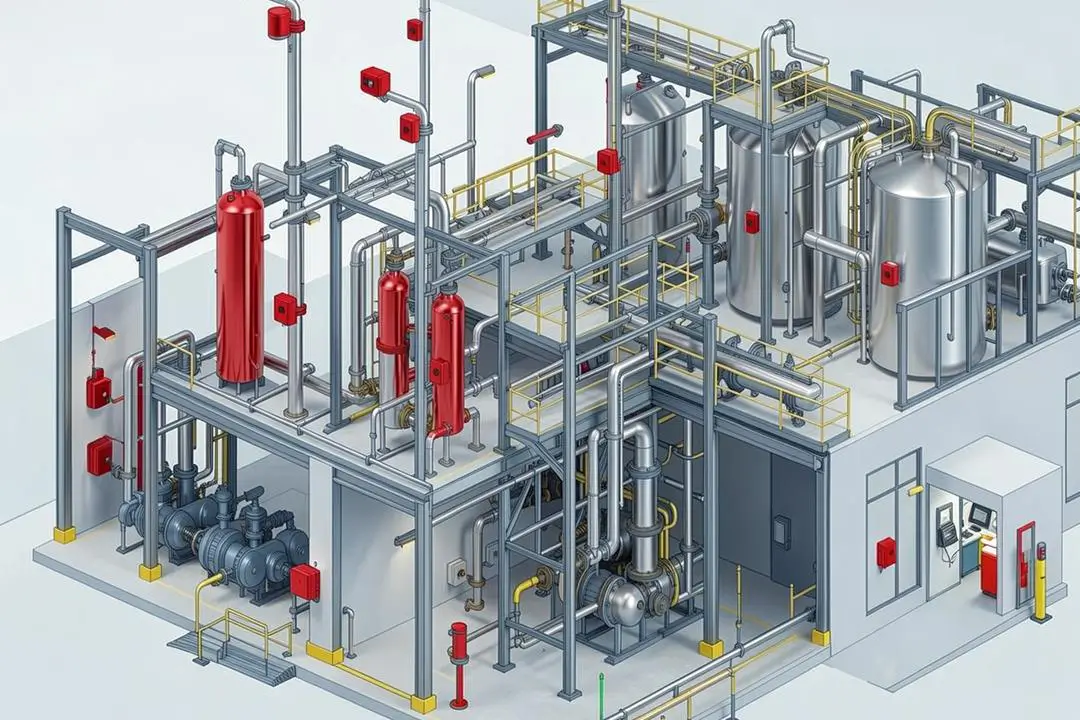
A Chemical Unit's Detection Layers
One storage-and-process footprint, four distinct detection missions.
P1Build the Gas Inventory First - the Real One
Not the SDS binder - the working truth. Walk every unit and list every gas present, its state (liquid under pressure, cryogenic, dissolved), its release mode, vapor density, and toxic/flammable thresholds. The inventory drives everything: sensor chemistries, ranges, setpoints, placement heights, and certification requirements. Plants that skip this step buy detectors by habit; plants that do it buy detection by design.
P2Layer the Detection Architecture
No single layer works alone. The robust pattern for chemical plants is four layers working together (see diagram above):
- Source detection at valves, seals, and pumps - the earliest possible warning, placed per vapor density
- Volume detection within process structures, where congestion hides accumulating gas
- Boundary detection - open-path or fenceline monitoring catching anything the inner layers missed
- Personal detection - the layer that goes where the worker goes, protecting against the scenario nobody predicted
P3Design Alarms for Response, Not Just Detection
In a plant where minutes matter, alarm philosophy is a safety function. Set toxic low-alarms at levels that trigger investigation, not panic; high-alarms that trigger evacuation and isolation automatically where possible. Integrate detection with emergency shutdown, deluge, and ventilation interlocks where risk assessment justifies it - and make sure control-room and field alarm paths are independent, so a single failure cannot silence both.
P4Fight Corrosion and Interference Proactively
The two chemical-plant-specific killers from R3 and R4 deserve standing countermeasures: corrosion-resistant housings and wetted materials in aggressive zones, shortened calibration intervals there, and a documented cross-sensitivity audit whenever the plant's chemical inventory changes - which is more often than anyone admits.
P5Maintain to the Environment, Not the Manual
Manufacturer intervals assume average service. A chemical plant is not average. Corrosive and high-exposure zones need shorter bump and calibration cycles; benign zones can run the standard schedule. Let exposure data - alarm history, over-range events, span drift - set the maintenance calendar zone by zone, and keep the records that prove it.
Common Chemical Plant Gases at a Glance
Starting reference - confirm thresholds and sensor choices against your specific inventory.
| Gas | Density vs Air | Key Concern | Detector Height |
|---|---|---|---|
| Chlorine (Cl2) | ~2.5 - heavier | Highly toxic at ppm; corrosive to plant & sensor | Low, near use/storage points |
| Ammonia (NH3) | ~0.6 - lighter | Toxic & flammable; refrigeration leaks | High, near ceiling/roofline |
| H2S | ~1.2 - slightly heavier | Toxic at ppm; sour service everywhere | Low-to-mid, at source points |
| Hydrogen (H2) | 0.07 - much lighter | Wide flammable range; invisible escape | High, under roofs and canopies |
| LPG / butane | ~1.5-2.0 - heavier | Flammable; pools and travels at grade | Low, in trenches and at grade |
| Solvent VOCs | Mostly heavier | Toxic chronic exposure + flammable | Low-to-mid, near use and storage |
| Nitrogen (N2) | ~1.0 - similar | Silent asphyxiant; O2 displacement | O2 monitoring at entry points |
The Difference Between Protected and Lucky
Chemical plants rarely get a second chance at the same release. The plants that come through incidents well are not the ones with the most detectors - they are the ones whose detection was designed around their actual chemistry, layered for defense in depth, and maintained against their actual environment. That is the whole difference between protected and lucky.
Chemical Plant Detection Checklist
- Working gas inventory per unit - state, release mode, vapor density, thresholds - reviewed on every process change
- Oxygen deficiency monitoring at confined-space entries and N2-heavy enclosures
- Sensor materials and housings rated for the ambient atmosphere, not just the target gas
- Cross-sensitivity audit performed against the full chemical inventory - and repeated at every chemistry change
- Four-layer architecture: source, volume, boundary, personnel - each with defined coverage
- Alarm philosophy tuned for response: investigation thresholds, evacuation thresholds, independent control-room and field paths
- Maintenance intervals set zone-by-zone by exposure data, not by the manual's default
If your plant's detection system predates its current chemistry, that gap is worth measuring. Explore our range of fixed and portable gas detection solutions, or reach us through respoproducts.com for application support across chemical, petrochemical, and specialty chemical environments.
Design for the chemistry you actually have.
Talk to Respo ProductsAuthor: Mr. Vishal Kaushal
Volume: Volume 32 of 53 FY26-27