|
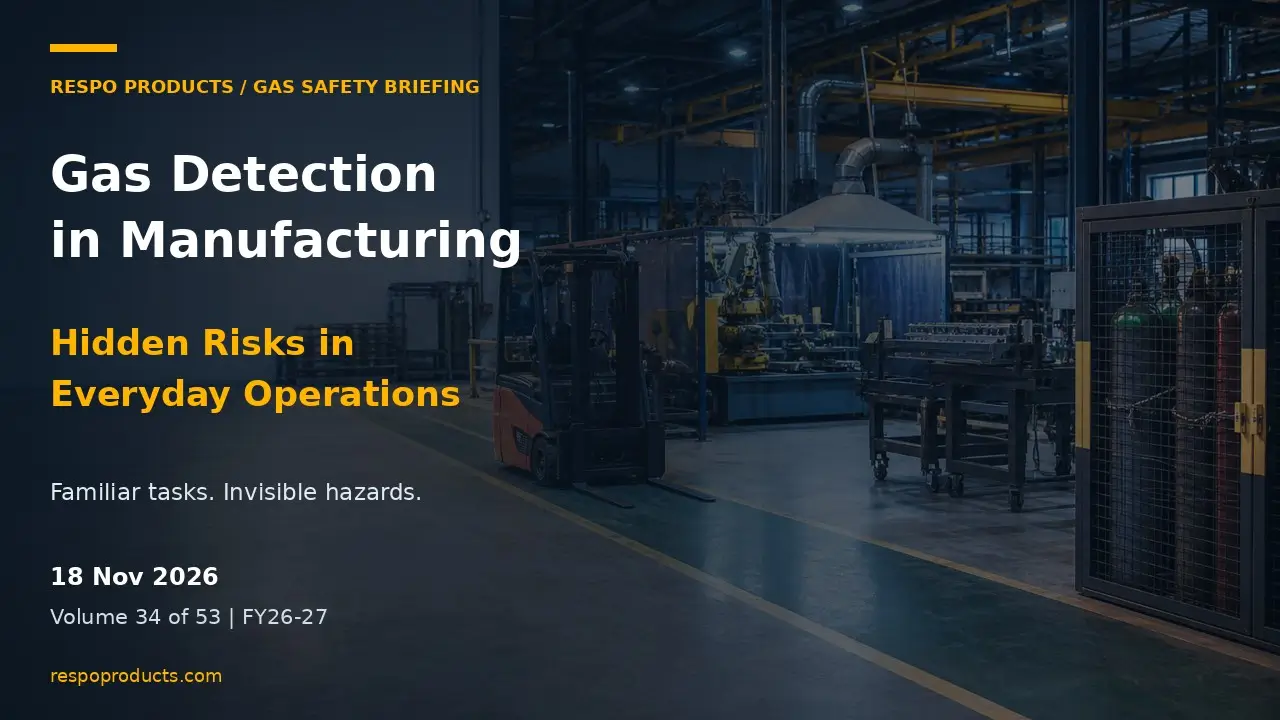
RESPO PRODUCTS / GAS SAFETY BRIEFING
18 Nov 2026 | Volume 34 of 53 FY26-27
Gas Detection in Manufacturing:
Hidden Risks in Everyday Operations
The most overlooked gas hazards are often attached to the most familiar jobs.
In a manufacturing facility, gas hazards do not always announce themselves with obvious warning signs. A routine maintenance task, a forklift left idling, or a sealed storage room can quietly create conditions where toxic, flammable, or oxygen-deficient atmospheres build up — often without any visible cue.
The result is that the most dangerous gas events rarely come from exotic equipment. They emerge from the same tasks performed in the same way, day after day — until the day the atmosphere becomes dangerous.
The Everyday Operations That Hide the Biggest Risks
Most gas incidents in manufacturing facilities are not triggered by dramatic failures. They emerge from ordinary tasks performed in ordinary conditions — which is precisely why they are so easy to overlook.
| Hazard |
Where It Hides |
Primary Risk |
| Carbon Monoxide (CO) |
Forklift exhaust, furnaces, generators |
Toxic — can be fatal within minutes |
| Hydrogen Sulfide (H₂S) |
Wastewater areas, tanks, digesters |
Toxic — deadens sense of smell at low levels |
| Methane (CH₄) |
Natural gas lines, storage bays |
Flammable — explosive at 5–15% concentration |
| Oxygen Deficiency |
Confined spaces, nitrogen purging zones |
Asphyxiation — no warning symptoms |
| Volatile Organic Compounds (VOCs) |
Solvents, paints, adhesives, cleaning agents |
Toxic — long-term exposure damage |
Why Routine Tasks Deserve a Second Look
Consider how many "ordinary" operations in a plant quietly create gas risk:
- A forklift idling in a warehouse can push CO levels to dangerous thresholds within minutes.
- Welding in an unventilated bay releases toxic fumes that may not be detected for hours.
- Cleaning with solvents in a closed room can accumulate VOCs well beyond safe exposure limits.
- Nitrogen purging in food packaging lines can silently displace oxygen in adjacent work areas.
- Battery charging stations release hydrogen gas that can accumulate in enclosed rooms.
Key insight: The human body cannot detect most dangerous gases. Carbon monoxide, methane, and oxygen deficiency are all invisible and odourless. By the time symptoms appear, exposure has often already reached a dangerous level.
Five Best Practices for Everyday Safety
- Fixed gas detection in high-risk zones — not just portable units carried by staff.
- Regular bump tests — verify sensor function before every shift, not just annually.
- Clear confined space entry protocols — never enter without pre-entry atmospheric testing.
- Adequate ventilation — design airflow to remove gases at the source, not after they spread.
- Regular worker training — so alarms are understood, acted on, and never ignored.
The Cost of Overlooking the Familiar
Gas incidents rarely come from exotic chemicals or unusual equipment. They come from the tasks your team performs every day, in the same places, in the same way — until the day the atmosphere becomes dangerous.
The most reliable defence is not vigilance alone. It is detection technology placed precisely where everyday operations quietly create risk — supported by training, testing, and a safety culture that treats "routine" as a reason to look closer, not to look away.
Request a Gas Detection Audit →
|