


Why Data Logging In Gas Detectors Is More Valuable Than Most Teams Realize
Ask most safety teams what they want from a gas detector and you'll hear the same short list: detect fast, alarm loud, survive the field. Data logging, if it comes up at all, usually lands near the bottom, filed under "nice to have."
That's a mistake. The log file is often the single most valuable thing a detector produces, and most teams only discover its worth after an incident, an audit, or a failed calibration that nobody saw coming. Here's why the humble data log deserves a promotion.
DETECTION TELLS YOU ABOUT NOW. LOGGING TELLS YOU ABOUT THE PATTERN.
An alarm is a snapshot: gas crossed a threshold, the horn sounded, someone responded. Useful, but it's a single frame from a much longer film.
A data log is the whole film. It captures the slow 50-ppm drift that never quite trips the alarm but climbs a little every week. It shows the recurring spike near the same valve every morning at shift change. It reveals that a sensor had been reading slightly high for a month before it finally failed.
None of that lives in an alarm event. All of it lives in the log. The difference between reacting to incidents and preventing them is almost entirely a data problem.
FIVE PLACES WHERE THE LOG QUIETLY EARNS ITS KEEP
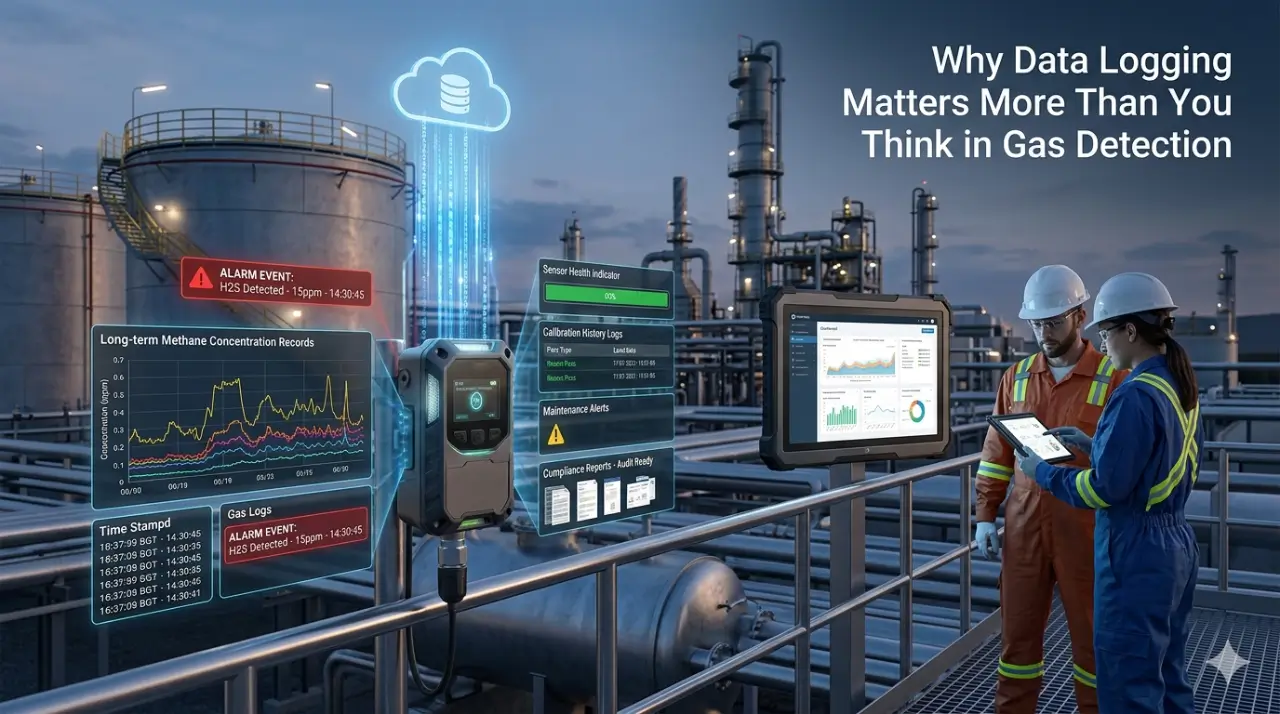
1. Incident investigation that holds up. A time-stamped record of concentrations, alarm states, and sensor health turns a roomful of conflicting memories into a defensible timeline. It protects your people and your organisation when regulators, insurers, or clients start asking.
2. Predictive maintenance instead of surprise failures. Sensors rarely fail off a cliff; they degrade. A logged history makes these trends visible early, so you replace a sensor on a planned schedule instead of discovering it's dead during the one event that mattered.
3. Calibration you can prove, not just promise. Logged calibration history (dates, span values, drift between calibrations) is the backbone of any credible compliance story. It also tells you whether your calibration interval is actually right.
4. Genuine root-cause analysis. Logged data lets you correlate gas events with process conditions, temperature, time of day, or specific operations. That's how a "mystery alarm" becomes "the seal on pump 3 leaks above 40C."
5. Audit and regulatory readiness. For oil & gas, CGD, and process industries, the question is no longer if you'll be asked for records but when. A detector that logs continuously turns audit season from a scramble into a download.
THE HIDDEN ECONOMICS
Unplanned sensor failures, emergency call-outs, over-conservative calibration schedules, and disputed incidents all cost real money, and data logging attacks every one of them:
- Sensors replaced reactively, after failure ≥ replaced on an evidence-based schedule
- Calibration intervals set by guesswork ≥ intervals tuned to actual drift
- Incident timelines reconstructed from memory ≥ exact, time-stamped record on demand
- Slow leaks invisible until they alarm ≥ trends caught weeks earlier
- Audit prep as a manual scramble ≥ audit prep as a data export
The hardware cost is fixed. The value you extract from what it records is almost entirely up to you.
LOGGING IS ONLY USEFUL IF YOU CAN ACTUALLY REACH IT
Here's the catch that traps many teams: a detector can log faithfully for years and still deliver zero value if that data is stranded inside the device, retrievable only by physically walking up to it with a laptop.
This is where modern, connected detection changes the equation. When logged data streams automatically to a central dashboard or the cloud, the log stops being a forensic tool you crack open after a disaster and becomes a living dataset: trends visible daily, sensor health flagged before failure, and records always one click from an auditor's request.
At Respo Products, this thinking sits at the core of how we build. Our wireless detection platform doesn't just sound an alarm and move on. It continuously records readings, alarm events, and device health, and makes that history accessible remotely rather than locking it inside a box in the field. The goal is simple: make sure the most valuable thing your detector produces is also the easiest thing to use.
THE TAKEAWAY
Detection keeps you safe in the moment. Logging makes you smarter over time, and a safety program that gets smarter every day is one that prevents incidents rather than merely surviving them.
So the next time you evaluate a gas detector, don't skim past the logging line on the datasheet. Ask the harder questions: How much does it store? How granular? How easily can you get the data out, and can you see it without standing in front of the device?
Because the alarm tells you about the crisis you're in. The log tells you about the one you can still avoid.