



How Electrochemical Sensors Work In Gas Detection
On 12 March 2024, a maintenance contractor at a wastewater treatment plant in Gujarat collapsed while inspecting a sludge tank. His portable gas monitor had shown a clean reading moments before. The investigation revealed the sensor for hydrogen sulfide had exceeded its recommended service life by 14 months — the electrolyte had effectively dried out, and the electrode catalytic surface had degraded to the point where the sensor reported zero in the presence of a lethal atmosphere. He was rescued, but spent three weeks in hospital.
This is not a story about a defective instrument. It is a story about a consumable component that was treated as permanent hardware. Electrochemical sensors are the most widely deployed toxic gas detection technology in the world — and they are also the most misunderstood.
After 30+ years protecting workers across Oil & Gas and heavy industry, here is what we tell every plant manager, safety officer, and instrumentation engineer who wants to understand the technology they are trusting with lives.
The core principle: a battery that runs on gas
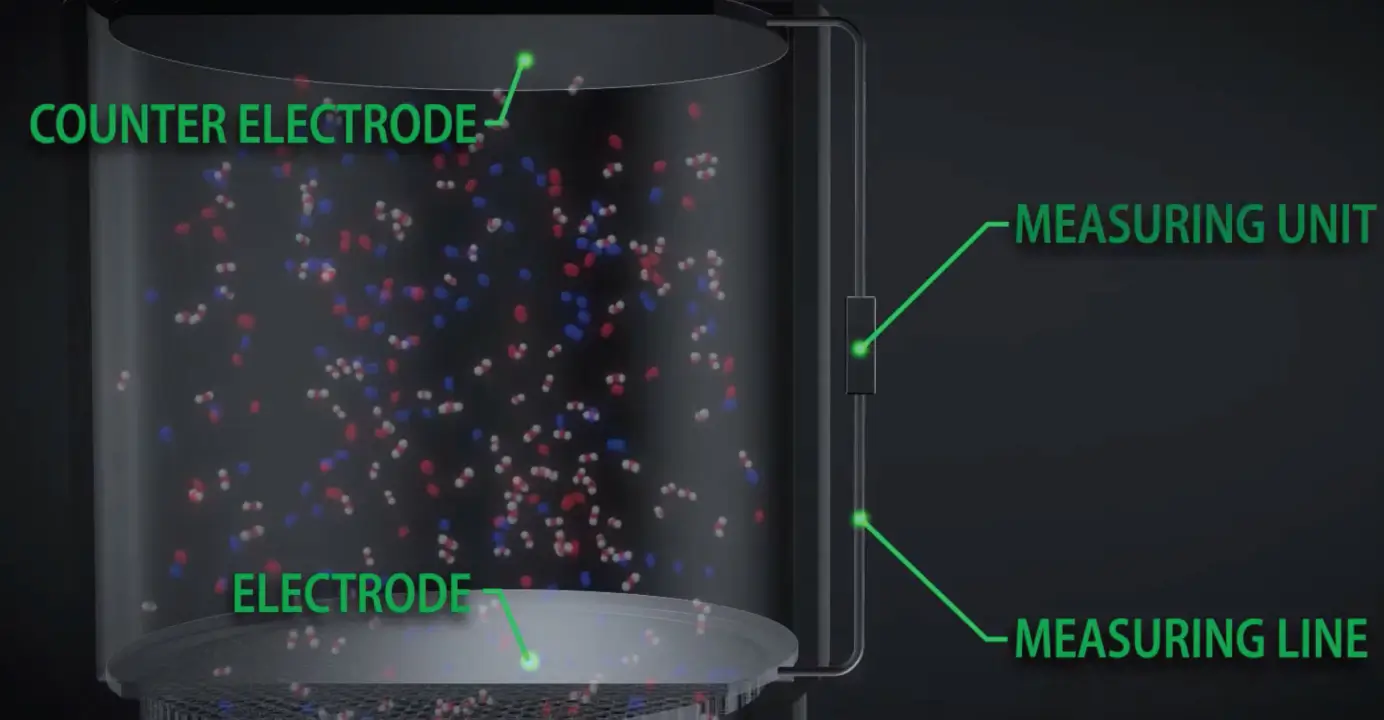
At its most fundamental level, an electrochemical gas sensor operates like a battery whose fuel is the target gas itself. Gas molecules diffuse through a gas-permeable membrane (typically PTFE) into the sensor cell, where they encounter a catalytic working electrode — usually a noble metal such as platinum or gold deposited on a porous hydrophobic substrate. There, the gas undergoes an electrochemical oxidation or reduction reaction in the presence of an electrolyte.
The reaction generates electrons at the working electrode, which travel through an external circuit to a counter electrode, producing a measurable electrical current. This current is directly proportional to the rate of gas consumption at the electrode — and because the capillary membrane controls the diffusion rate of gas into the cell, the resulting micro-amp signal is a linear function of the gas concentration outside the sensor.
This relationship is governed by Faraday's Law of Electrolysis: the current (I) equals the number of electrons transferred (n) multiplied by Faraday's constant (F) and the gas flux (J). The linearity of this response is what makes electrochemical sensors so well-suited for quantitative ppm-level measurement — you get a clean, predictable signal that maps directly to concentration.
Two-electrode vs three-electrode: why the reference electrode matters
Early electrochemical sensors used a simple two-electrode design — a working electrode and a counter electrode. The problem: as gas concentration rises, the counter electrode polarises (its electrochemical potential shifts), causing the working electrode potential to drift. The result is non-linear response at higher concentrations and gradual baseline shift.
Modern industrial-grade sensors use a three-electrode potentiostatic configuration. The third electrode — the reference electrode — maintains a stable, fixed potential at the working electrode. Because no significant current flows through the reference electrode, its potential remains essentially constant regardless of gas concentration. A potentiostat circuit in the instrument continuously adjusts the counter electrode voltage to hold the working electrode at the correct potential relative to the reference.
If you are specifying sensors for a demanding application — high background gas concentrations, varying temperature, or long calibration intervals — the three-electrode design is not optional. It is the minimum.
What happens at the electrode: oxidation vs reduction
Different target gases react at the working electrode in fundamentally different ways, and understanding this helps explain why sensor selection is gas-specific:
| Gas | Reaction Type | Half-Reaction (Simplified) |
|---|---|---|
| Carbon Monoxide (CO) | Oxidation | CO + H2O → CO2 + 2H+ + 2e- |
| Hydrogen Sulfide (H2S) | Oxidation | H2S → S + 2H+ + 2e- |
| Hydrogen (H2) | Oxidation | H2 → 2H+ + 2e- |
| Sulfur Dioxide (SO2) | Oxidation | SO2 + 2H2O → SO4²- + 4H+ + 2e- |
| Ammonia (NH3) | Oxidation | 2NH3 → N2 + 6H+ + 6e- |
| Oxygen (O2) | Reduction | O2 + 4H+ + 4e- → 2H2O |
| Nitrogen Dioxide (NO2) | Reduction | NO2 + 2H+ + 2e- → NO + H2O |
| Chlorine (Cl2) | Reduction | Cl2 + 2e- → 2Cl- |
Gases that are oxidised release electrons at the working electrode (the sensor acts as a galvanic cell). Gases that are reduced consume electrons (the instrument must drive the reaction by applying a bias voltage). This distinction matters because reduction-type sensors — particularly oxygen sensors — require a bias voltage to be maintained by the instrument electronics, which has implications for power consumption and warm-up time.
Selectivity and cross-sensitivity: the hidden trap
No electrochemical sensor is perfectly selective. The catalytic electrode materials that react with your target gas will also, to varying degrees, react with other gases present in the environment. This is cross-sensitivity, and it is one of the most dangerous — and least understood — failure modes in gas detection.
A classic example: a standard CO sensor will produce a significant response when exposed to hydrogen (H2). A CO sensor reading 100 ppm in an environment that actually contains 200 ppm of H2 and 50 ppm of CO is not just inaccurate — it is actively misleading. In a refinery or petrochemical plant where H2 is present alongside CO, this can mean the difference between a safe evacuation and a false sense of security.
Manufacturers address cross-sensitivity through two main strategies:
- Chemical filters: A scrubber material placed in the gas path before the electrode selectively removes known interfering gases. For example, an activated carbon filter can remove most hydrocarbons and solvents before they reach a CO sensor. But filters have finite capacity — once saturated, they stop protecting.
- Electrode bias tuning and catalyst selection: By choosing specific catalyst materials and reference electrode potentials, manufacturers can suppress the sensor's response to certain interferents. This is why a "CO-low H2 cross" sensor costs more than a standard CO sensor — the electrode formulation is engineered to minimise H2 response.
The lesson for specifiers: always read the cross-sensitivity table in the sensor datasheet. If your environment contains gases that produce a cross-response of more than 10% on your target sensor channel, you need either a filtered sensor variant or a different detection technology.
Why electrochemical sensors die — and how to plan for it
Electrochemical sensors are consumable components. They degrade from the moment they are manufactured, whether or not they are in use. Understanding the failure mechanisms is essential for maintenance planning:
- Electrolyte depletion: The liquid electrolyte (typically an acid or alkaline solution) is consumed by the sensing reaction itself. Over the sensor's life, the electrolyte gradually depletes. In low-humidity environments, the electrolyte can also dry out through the gas-permeable membrane. In high-humidity environments, the electrolyte absorbs atmospheric water, diluting the concentration and potentially causing leakage. Both extremes shorten sensor life.
- Electrode poisoning: Exposure to very high concentrations of the target gas — or to solvent vapours, silicones, or sulphur compounds — can permanently coat or deactivate the catalytic electrode surface. A sensor exposed to a massive H2S slug may never recover its original sensitivity.
- Temperature extremes: The electrochemical reaction rate is temperature-dependent. Most sensors are specified for -20C to +50C. Below that range, response becomes sluggish and the signal may under-read. Above it, electrolyte evaporation accelerates and baseline drift increases. Sensors installed outdoors in Indian summer conditions without thermal management will have shorter service lives.
- Shelf life: Even unused, electrochemical sensors have a finite shelf life — typically 6 to 12 months in sealed packaging. The electrolyte degrades and the electrode surface oxidises over time. Installing a sensor that has been sitting in a storeroom for a year is not the same as installing a fresh one.
The typical service life of a liquid-electrolyte electrochemical sensor is 18 to 36 months, depending on the gas type, environmental conditions, and exposure history. Oxygen sensors tend to be shorter (12-24 months) because the lead anode is consumed continuously. Ammonia and chlorine sensors are also shorter-lived due to electrolyte aggression. CO and H2S sensors in moderate environments can reach the upper end of the range.
Advantages over alternative technologies
Electrochemical sensors are not the only technology — but for toxic gas detection at ppm levels, they are the dominant choice for good reason:
| Feature | Electrochemical | NDIR | Pellistor | MOS |
|---|---|---|---|---|
| Target gases | Toxic (CO, H2S, NH3...) | Hydrocarbons, CO2 | Combustible (LEL) | Broad (non-selective) |
| Sensitivity | ppm to ppb | ppm to % | % LEL | ppm to % |
| Power consumption | Very low | Moderate | High | Low |
| Selectivity | Good (with filters) | Excellent | Poor | Poor |
| Service life | 18-36 months | 5-10+ years | 3-5 years | 5-10 years |
| Temp range | -20C to +50C | -40C to +65C | -40C to +75C | -40C to +60C |
| Cost | Low to moderate | High | Low | Very low |
The key advantage of electrochemical technology is its combination of high sensitivity (ppm and below), low power consumption (enabling battery-operated portables), and reasonable selectivity. The key trade-off is that the sensor is a consumable — it wears out and must be replaced on a planned schedule, not when it fails.
The future: SPE, nano-structured electrodes, and MEMS
The electrochemical sensor industry is not standing still. Three innovation tracks are reshaping the technology:
- Solid Polymer Electrolytes (SPE): Replacing the liquid acid or alkaline electrolyte with an ion-conducting solid polymer matrix eliminates the failure modes associated with liquid — leakage, drying out, humidity-driven swelling, and orientation sensitivity. SPE sensors can operate in any position, survive wider humidity ranges, and offer significantly longer service lives. This is the most important near-term advancement for industrial safety applications.
- Nano-structured electrodes: By engineering the working electrode surface at the nanoscale — using carbon nanotubes, graphene, or nano-porous gold — manufacturers can dramatically increase the catalytic surface area. The result: faster response times (T90 under 5 seconds), higher sensitivity (into the parts-per-billion range), and reduced cross-sensitivity through more selective catalytic sites.
- MEMS miniaturisation: Micro-Electromechanical Systems fabrication techniques are shrinking electrochemical cells to chip-scale dimensions. This enables multi-gas arrays in a single small package, integration into wearable PPE, and lower per-unit costs through semiconductor-style batch manufacturing. The trade-off is that miniaturised sensors typically have shorter service lives due to reduced electrolyte volume — a challenge that SPE technology is helping to address.
These advancements are not laboratory curiosities. They are entering commercial sensors now, and within the next few years they will change what is possible in portable and wearable gas detection.
Electrochemical sensors are the workhorse of toxic gas detection — and like any workhorse, they perform reliably only when they are understood, maintained, and replaced on schedule. The most dangerous failure mode in gas detection is not a sensor that reads high. It is a sensor that reads zero when it should be reading danger. A depleted electrolyte, a poisoned electrode, or a saturated chemical filter all produce the same outcome: a clean reading in a lethal atmosphere.
We have spent 30+ years in the field with these sensors, and our approach has always been the same: understand the technology, match it to the hazard, and never let a consumable component become a silent failure point. We carry PESO-approved and BIS-certified (IS/IEC 60079) fixed and portable gas detection solutions, and our field experience — 100+ turnkey projects, 500+ satisfied clients across India's leading PSUs and private sector — has taught us that the difference between a safety system that works and one that fails silently is almost always in the maintenance discipline, not the initial specification.
If your facility relies on electrochemical sensors for toxic gas detection — and if you are in Oil & Gas, petrochemicals, wastewater, mining, or chemical processing, you almost certainly do — talk to our team about your sensor lifecycle management. We will help you audit your current sensor population, establish a replacement schedule based on actual exposure history rather than calendar defaults, and ensure that every sensor in your facility is within its service life and performing to specification.
Because the sensor does not know it is dying. That is your job — and ours.